


Cart
0
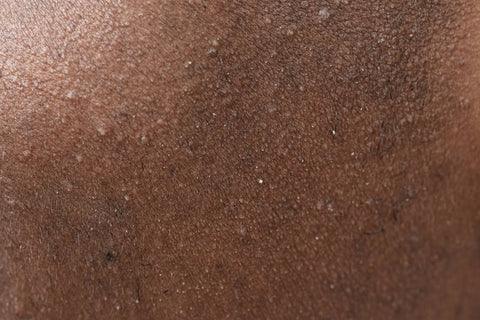
Small rough bumps on the back of your arms, thighs, or buttocks, skin that looks like permanent “goosebumps,” sometimes surrounded by tiny dark dots… This is most likely keratosis pilaris. Keratosis pilaris on Black skin is harmless and very common, but it shows more on Black and mixed-race skin, because each little bump can leave a dark mark. As a nurse, I'll explain how to recognize it and how to smooth your skin without damaging it.
What is keratosis pilaris?
Keratosis pilaris is a keratinization disorder: keratin, the protein that forms the outer layer of the skin, builds up at the opening of hair follicles and forms small plugs. The result: bumpy skin that feels rough to the touch, like sandpaper.
It is often hereditary, common in people with dry skin or eczema, and it tends to get worse in winter when the air is dry. It is not contagious and has nothing to do with poor hygiene.
How to recognize it on Black skin
- Where? The back of the arms, thighs, buttocks, sometimes the cheeks and legs.
- What does it look like? Tiny pinhead-sized bumps, skin-colored or darker, that don't hurt.
- How does it feel? Bumpy, rough skin that stays “scratchy” even with moisturizer.
- What's specific to darker skin: the skin around each follicle can darken. You then see lots of small brown dots that give a “speckled” look. This is post-inflammatory hyperpigmentation, often made worse by scratching or rubbing too hard.
Keratosis pilaris, ingrown hairs, or folliculitis: don't confuse them
- Keratosis pilaris: dry, rough, painless bumps, very numerous and evenly spread.
- Ingrown hairs: isolated bumps after shaving or waxing, sometimes with a hair visible under the skin.
- Folliculitis: small red or white pus-filled bumps that hurt or itch. If that's your case, ask a healthcare professional for advice.
Does keratosis pilaris go away for good?
Let's be honest: there is no treatment that makes it disappear forever. It often fades with age. However, with a consistent routine, skin usually feels noticeably smoother within 4 to 8 weeks, and the little dark marks gradually fade. The key is consistency.
My 5 steps for smoother skin
1. Exfoliate chemically, gently
Ingredients that dissolve keratin plugs work best: lactic acid, urea (10% and up) and salicylic acid. They work without scrubbing, which is essential on Black skin. Apply them in the evening, a few times a week at first, then increase if your skin tolerates them well.
2. Add a gentle scrub, no more than once or twice a week
A fine-grain sugar scrub helps lift buildup from the surface. Massage without pressing, in small circles. Skip exfoliating gloves and hard grains: they irritate follicles, increase redness, and leave marks.
3. Moisturize every day, right after your shower
Dry skin produces more keratin. Apply a body lotion to still-damp skin. Our Fig & Honey body lotion combines glycerin and lactic acid: it hydrates and helps skin feel smoother day after day. On very rough areas, add a body butter at night.
Aissatou's tip
Fig & Honey hydrating body lotion: glycerin and lactic acid to hydrate and help skin feel smoother every day, with no greasy feel. €29.90.
4. Make your shower gentler
Take lukewarm rather than hot showers, no longer than 10 minutes, with a gentle soap-free cleanser. Very hot water and harsh soaps dry out the skin and trigger keratosis pilaris again.
5. Don't scratch, don't pick
This is the hardest habit, and the most important one on Black skin: every bump you scratch or squeeze can leave a dark mark for months.
What about the dark spots left by keratosis pilaris?
They fade on their own once the inflammation stops. To help them along, lactic acid, niacinamide, or azelaic acid are good allies. And protect sun-exposed areas, especially if you use acids. To learn more, read my complete guide to dark spots on Black skin.
Mistakes that make keratosis pilaris worse
- Scrubbing hard with an exfoliating glove or a brush.
- Exfoliating every day.
- Applying lemon juice or baking soda.
- Skipping moisturizer because you think “skin needs to breathe.”
- Stopping your routine as soon as your skin improves: keratosis pilaris comes back within a few weeks.
When to see a doctor
See a doctor or a dermatologist if the bumps become red, painful, or filled with pus, if they spread quickly, or if nothing improves after 3 months of a consistent routine. Prescription treatments are available.
Frequently asked questions
Why is the skin on my arms bumpy?
In the vast majority of cases, it's keratosis pilaris: small keratin plugs in the follicles, linked to dry skin and genetics.
Bumpy skin on my thighs: what should I do?
The same routine applies: gentle chemical exfoliation, a fine scrub once or twice a week, daily moisturizing, and less friction (avoid clothes that are too tight).
Does lactic acid work for keratosis pilaris?
Yes, it's one of the best-suited ingredients: it dissolves keratin plugs while hydrating, and it is well tolerated by Black skin.
Can azelaic acid help?
It mainly works on the dark marks around the follicles. It's a good addition to a keratosis pilaris routine, but it doesn't replace exfoliation and moisturizing.
Does aloe vera work?
It calms and hydrates, which can make skin feel more comfortable, but it does not dissolve keratin plugs. Use it as a complement, not as your main step.
In short
Keratosis pilaris can't be “cured,” but it can be kept well under control: gentle chemical exfoliation, a fine and moderate scrub, daily moisturizing, and zero scratching. On Black skin, gentleness is what makes the difference between smooth skin and marked skin. Find every step in our body care routine for Black and mixed-race skin.
Your complete routine
Essential Ritual: a sugar body scrub, body lotion, and body butter in the same scent, to smooth, hydrate, and nourish. €94.90, free shipping.
Written by Aissatou, a nurse for more than 10 years and founder of WITH CARE.


