Cart
0

A body scrub for Black skin is one of the most misused steps in body care for Black and mixed-race skin. Too often, we scrub too hard, too often, with the wrong textures. The result: micro-inflammation, post-exfoliation hyperpigmentation, and skin that reacts instead of glowing.
As a nurse, I created the WITH CARE body scrubs around one simple observation: exfoliating melanin-rich skin isn't something you improvise. It's something you learn.
In this complete guide, I'll explain everything: why you should exfoliate, how to choose your body scrub, how often to use it, and how to avoid the mistakes that do more harm than good.
Why exfoliate your body when you have Black skin?
Your skin naturally renews itself by shedding dead cells. This process, called desquamation, takes about 28 days in young adults, and longer with age. But when this renewal slows down (because of cold weather, stress, lack of moisture or simply age), dead cells build up on the surface.
On Black and mixed-race skin, this buildup is especially visible: it's ashy skin, that grayish film that dulls your complexion and hides your skin's natural glow. The areas most affected are the elbows, knees, shins, heels and ankles.
A regular body scrub helps:
- Remove the dead skin cells that dull your complexion
- Reveal your skin's natural radiance
- Help the body lotion or body butter you apply afterward absorb better
- Smooth skin texture
- Reduce the risk of ingrown hairs after hair removal
But be careful: scrubbing too hard or too often creates micro-damage. And on melanin-rich skin, any micro-injury can trigger a pigment reaction. Gentleness and consistency always beat intensity.
The different types of body scrubs
Not all exfoliants are created equal. Before choosing, you need to understand what sets textures and methods apart.
Mechanical (physical) scrubs
They exfoliate through friction, using abrasive particles. This is the most common category.
Good choices for Black skin:
- Fine sugar: gentle, melts on contact with water, ideal for the body
- Fine sea salt: slightly more exfoliating, good for thicker skin
- Coffee grounds: invigorating, generally well tolerated
- Finely ground nut or seed powders
What to avoid:
- Coarsely crushed fruit pits or shells (apricot, coconut): too abrasive, they create micro-cuts
- Coarse salt crystals on sensitive areas
- Kessa gloves or loofahs used with too much pressure
Chemical (or enzyme) exfoliants
They exfoliate without friction, by loosening the bonds between dead skin cells. Ideal for reactive or sensitive skin.
- AHAs (alpha hydroxy acids): lactic acid, glycolic acid, mandelic acid. Gentle when well dosed, they can help with the look of dark spots and dullness.
- BHA (beta hydroxy acid): salicylic acid. Works inside the pores, suited to blemish-prone skin.
- Enzymes: papain (papaya), bromelain (pineapple). Very gentle, perfect for sensitive skin.
For Black and mixed-race skin prone to hyperpigmentation, gentle chemical exfoliants are often safer than intense mechanical scrubs.
How to choose a body scrub for your skin type
Dry to very dry skin
Go for a sugar- or oil-based scrub with nourishing ingredients like shea butter or coconut oil. The goal is to exfoliate without drying your skin out even more.
Normal to combination skin
Most body scrubs will work. Look for a balanced texture, neither too oily nor too light, with medium-sized particles.
Sensitive or reactive skin
Avoid intense mechanical scrubs. Choose an enzyme exfoliant or a very fine scrub, applied with minimal pressure.
Skin prone to ingrown hairs
A body scrub is your best friend. Exfoliate the day before hair removal to free hairs trapped under the skin, then again 48 hours after to help reduce new ingrown hairs.
How to use a body scrub: the perfect technique
Technique matters as much as the product. Here's the routine I recommend.
Before your scrub: prep your skin
Wet your skin with lukewarm water for two to three minutes in the shower. The warm water softens dead skin cells, which makes exfoliation more effective and less harsh.
During your scrub: gentle, circular motions
Apply the body scrub to damp skin (not directly under the running water). Massage in gentle circular motions, working upward, from your feet toward your heart. Focus on dry areas: elbows, knees, heels, shins.
The golden rule: no pressure. The product does the work, not force. If your skin turns red, you're scrubbing too hard.
Leave it on for one to two minutes on ashy areas before rinsing.
After your scrub: the step that seals it all in
Rinse thoroughly with lukewarm water, then pat your skin dry with a soft towel. Immediately apply your moisturizing body lotion or body butter while your skin is still slightly damp. That's when moisturizing ingredients work best.
How often should you use a body scrub?
It's the question I get asked most. And the answer is always the same: less often than you think.
On Black and mixed-race skin, exfoliating too often weakens the skin barrier and can trigger pigment reactions.
Recommended frequency:
- Normal skin: once a week
- Dry or sensitive skin: once every 10 days
- Very dry or reactive skin: once every 2 weeks
In winter, your skin is more vulnerable: reduce the frequency and choose gentler textures. In summer, you can increase it slightly if your skin tolerates it well.
Mistakes to avoid at all costs
Exfoliating irritated or broken skin
Never scrub over a sunburn, a cut, active eczema or an inflamed area. Any existing irritation will get worse.
Using the same scrub on your face and body
The skin on your face is much thinner than the skin on your body. A body scrub is always too abrasive for the face. Use dedicated products for each area.
Rinsing with very hot or very cold water
Very hot water dries the skin out, and very cold water is less effective at rinsing away the scrub and loosened dead cells. Always rinse with lukewarm water.
Not moisturizing afterward
Exfoliation temporarily makes the skin barrier more vulnerable. Without moisturizing right away, your skin loses water and dries out. It's mistake number one.
Exfoliating more often because your skin "itches"
If your skin feels tight or itchy, the problem is often a lack of moisture, not too many dead cells. Before scrubbing more often, step up your daily moisturizing first. If the itching persists, see a doctor.
WITH CARE body scrubs: created for Black & mixed-race skin
Our exfoliating body scrubs were developed with two priorities in mind: effective exfoliation and respect for melanin-rich skin. Each formula combines:
- Fine sugar crystals for gentle, even exfoliation, with glycolic acid
- Shea butter and plant oils, including sweet almond oil, to nourish while you exfoliate
- Carefully chosen scents
- Formulas designed with sensitive, melanin-rich skin in mind
Available in four signature scents:
- Ylang-Ylang & Coconut: soft, floral and exotic
- Mango & Papaya: tropical energy and lightness
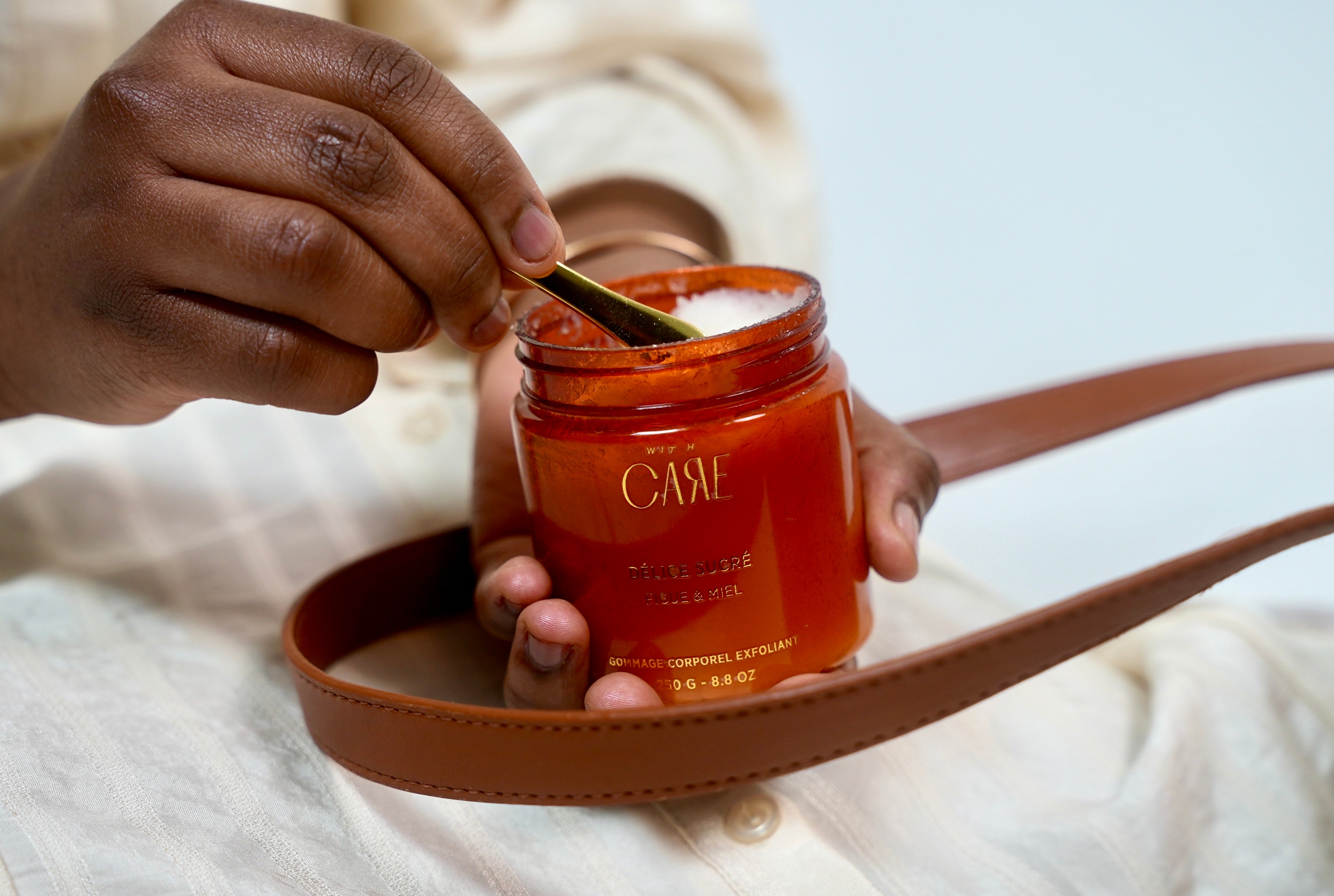
- Fig & Honey: warm, gourmand and enveloping
- Oud & Patchouli: deep, woody and sensual
For best results, pair your scrub with our moisturizing body lotion or our body butter as part of a complete routine.
Making your body scrub part of a complete body care routine
A body scrub doesn't work on its own. It makes the most sense as part of a structured routine:
Step 1: Exfoliate (once a week or less, depending on your skin) Exfoliating body scrub on damp skin, gentle circular motions, rinse with lukewarm water.
Step 2: Moisturize (every day) Moisturizing body lotion applied right after your shower, on slightly damp skin.
Step 3: Nourish (as needed) Body butter on dry areas, or a scented body oil for extra glow.
This three-step routine is at the heart of our body care gift sets, designed to simplify your daily routine while bringing out visible results.
Frequently asked questions about body scrubs
Can you make a DIY body scrub? Yes, as long as you choose suitable ingredients. Fine sugar and honey are a good base for dry skin. Coffee grounds mixed with a plant oil suit normal skin. Avoid salt scrubs on sensitive skin: salt is too abrasive and can irritate. For more consistent results and balanced formulas, a formulated scrub is more reliable.
Does a body scrub help with cellulite? A scrub boosts surface circulation and can temporarily improve the look of orange-peel skin, but it doesn't get rid of cellulite. It improves the overall look of your skin and makes it more receptive to the products you apply next.
Can you use a body scrub during pregnancy? Gentle mechanical scrubs are generally well tolerated, but some active ingredients (highly concentrated essential oils, strong acids) are not recommended. Check with your doctor or midwife before adding new products to your routine.
Body scrub before or after shaving? Before, not right after. Exfoliating before shaving frees the hairs and gives a better result. Right after shaving, your skin is too sensitive and a scrub would make irritation worse; wait about 48 hours.
The bottom line
Exfoliating Black or mixed-race skin is an essential step, as long as you do it with the right techniques and the right products. The right body scrub reveals your natural glow, helps reduce the ashy look, smooths skin texture and preps your skin for moisture.
The key: gentle particles, no-pressure movements, a reasonable frequency, and always moisturizing right after.
Discover our exfoliating body scrubs, created by a nurse and specially designed to respect and enhance Black and mixed-race skin.
Written by Aissatou, a nurse for more than 10 years and founder of WITH CARE.