Cart
0

Eczema skin care changes your whole relationship with your skin. Every new product feels like a risk, every change of season a source of worry. Many women I talk to have a routine built on years of trial and error, often going without enjoyable products for fear of triggering a flare.
As a nurse and the founder of WITH CARE, I wanted our formulas to be designed with sensitive skin in mind. Here's what you need to know to build a gentle, natural routine that keeps your skin comfortable while limiting the risk of making symptoms worse.
Understanding eczema to care for it better
Eczema, or atopic dermatitis, is a chronic inflammatory skin condition linked to a weakened skin barrier. In people with eczema, this barrier lets water escape more easily (hence the typical dryness) and lets irritants in more easily (hence the inflammatory flares).
This double vulnerability explains why eczema-prone skin reacts to products that other skin tolerates very well. It's not excessive or imaginary sensitivity: it's a measurable physiological reality.
On black and mixed skin, eczema has an extra feature: each flare often leaves post-inflammatory hyperpigmentation that lasts for weeks after the inflammation itself has gone. Managing eczema on deeper skin tones is therefore also about limiting these lingering dark marks, ideally with the help of a dermatologist.
Ingredients to avoid
Before talking about what helps, let's rule out what can make things worse. Eczema-prone skin often doesn't tolerate some ingredients that are very common in conventional cosmetics.
Denatured alcohol, found in many mists and lotions to help the scent last, dries the skin right away and further weakens an already compromised skin barrier.
Fragrance is one of the most common triggers of flares in atopic skin. Even in small amounts, fragrance ingredients, whether synthetic or natural, can cause an allergic or irritant reaction.
Sulfates, used as foaming agents in many shower gels, strip the skin's protective hydrolipidic film and leave it exposed to outside aggressors.
Some preservatives, such as methylisothiazolinone, are recognized allergens for atopic skin.
Pure essential oils, despite their natural, feel-good image, are highly concentrated and are among the most frequent contact allergens for eczema-prone skin. Being natural doesn't automatically make them safe.
Natural ingredients that help keep skin comfortable
On the other hand, some natural ingredients are generally well tolerated and help comfort and support eczema-prone skin.
Raw shea butter is one of the best-tolerated ingredients. Rich in essential fatty acids and vitamins A and E, it helps replenish the skin's protective film and comforts tight-feeling skin. Its rich texture makes it a lovely ally for intensive nourishment between flares.
Grape seed oil, light and non-comedogenic, is rich in vitamin E and linoleic acid. Its lightweight, gentle texture makes it well suited to reactive skin, without clogging pores.
Hyaluronic acid, despite its chemical-sounding name, is naturally present in the skin. It attracts and holds water in the upper layers of the skin, which helps offset the water loss typical of atopic skin.
Honey, especially raw, minimally processed honey, has long been valued in skin care for its moisturizing properties. It helps attract moisture to the skin's surface. Broken, oozing or infected-looking skin always needs medical attention, not a home remedy.
Colloidal oatmeal, although not in our current formulas, is widely recognized in dermatology for comforting atopic skin. It's a good ingredient to know if you're looking to complement your routine.
The recommended routine between flares
Between flares, the goal is to support the skin barrier over the long term to help keep skin comfortable.
Very gentle exfoliation, once a week at most, with a fine-grain scrub on a nourishing base. Never on an area showing even the slightest sign of a flare. Massage gently without pressing and rinse thoroughly.
Daily moisturizing, ideally twice a day, morning and night. A body lotion with glycerin applied to still-damp skin after showering, followed if needed by a body butter on the driest areas or those where flares have appeared in the past: elbows, knees, skin folds.
Short, lukewarm showers rather than long, hot ones. Hot water dissolves the already fragile protective film and adds to post-shower dryness.
Pat dry, never rub. A soft towel, pressed on lightly, protects skin that's still fragile after contact with water.
What to do during a flare
During an active flare, the top priority is to comfort the skin without irritating it further.
Stop all exfoliation on the affected area, even gentle exfoliation. Inflamed skin can't handle any extra friction.
Apply a generous layer of a rich, simple moisturizer several times a day if needed, to ease the feeling of tightness and limit water loss.
Avoid any new, untested product during a flare. It's the worst time to introduce something new: if you react, it becomes impossible to know whether it's the flare itself or the new product.
If the flare is widespread, very inflamed, oozing, or doesn't improve after a few days, see a doctor or dermatologist. Some flares need medical treatment, such as topical corticosteroids, which only a healthcare professional can prescribe.
How to test a new product safely
For eczema-prone skin, introducing a new product calls for a careful method to limit the risks.
First apply a small amount to a test area, such as the inside of your wrist or the crook of your elbow, away from any active flare. Watch it for forty-eight hours. If there's no redness, itching or discomfort, gradually extend to a larger area over a week before adding it to your full routine.
Never introduce two new products at the same time. If you react, you won't be able to tell which one is responsible.
A WITH CARE routine for sensitive skin
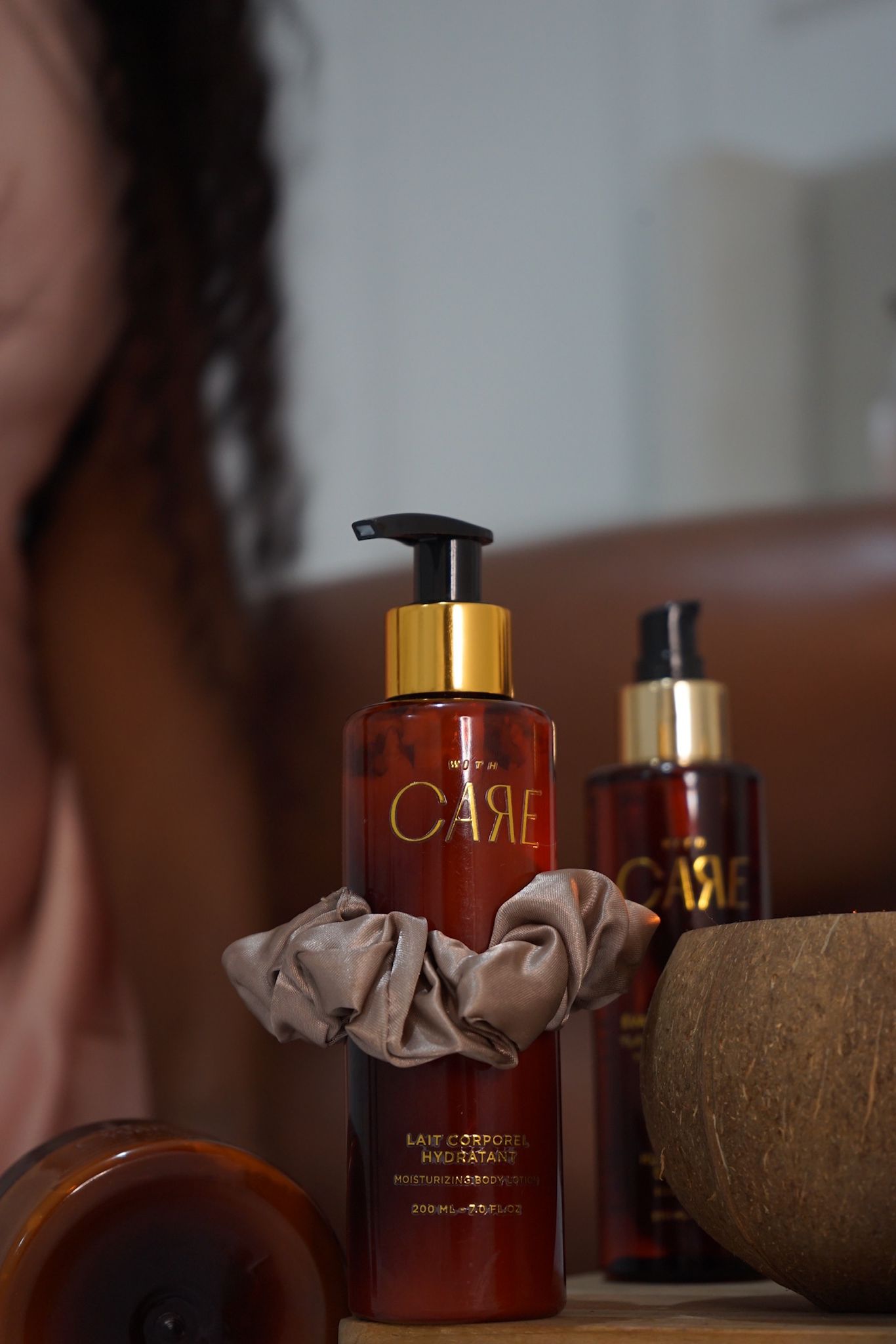
WITH CARE products are made with sensitive skin in mind. Our Fig & Honey range, with its fig fragrance and honey extract, was designed as the brand's most versatile signature scent. Because every eczema-prone skin is different and all our products are scented, always do a patch test first, avoid using them during a flare, and ask your dermatologist if you have any doubt.
In a maintenance routine, apply the body lotion every morning to damp skin, followed by the body butter on the areas most prone to past flares. Once a week at most, a sugar body scrub helps your skin absorb the next products better, always away from any inflamed area.
In short
Eczema calls for a carefully built routine: avoid irritating ingredients, favor gentle, well-tolerated natural ingredients, moisturize generously and consistently, and adapt your habits depending on whether your skin is flaring or calm. On black and mixed skin, this routine should also aim to limit the dark marks that can follow each flare.
This article is for information only. If eczema affects you significantly or keeps coming back, a dermatologist's advice remains essential alongside a suitable skin care routine.
Discover the WITH CARE Fig & Honey range, made with sensitive and reactive skin in mind.
Written by Aissatou, a nurse for more than 10 years and founder of WITH CARE.